
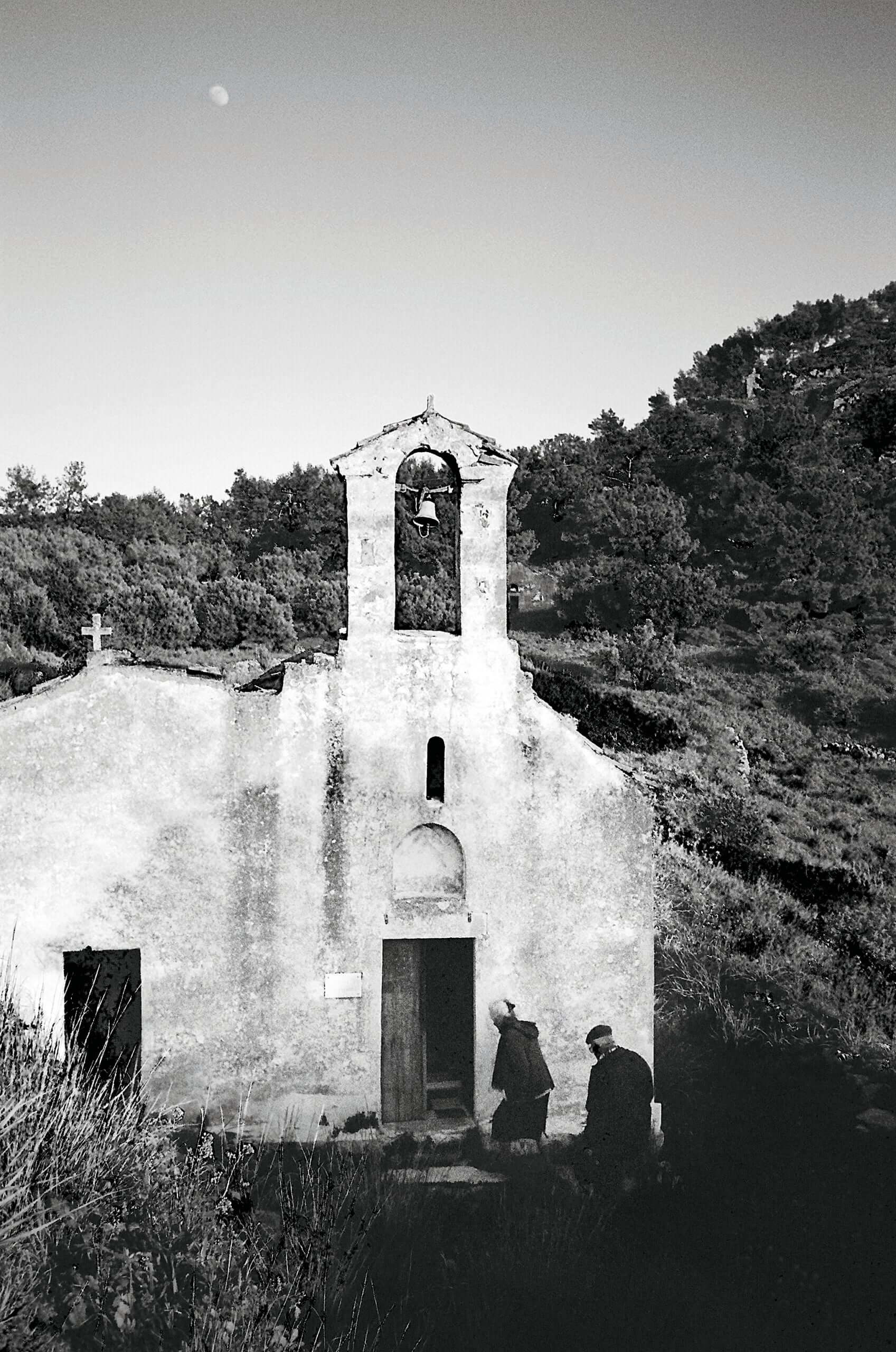
An Image of Quiet Resurrection
When I first captured this photograph, I wasn’t thinking about publication, let alone seeing it featured in Kathimerini. It was simply a moment—one of those fleeting instances where light, place, and feeling align almost without permission. Yet, within the context of the article “Easter Brought an Inner Resurrection,” the image found a deeper voice.
The photograph, originally published in the Myrmidones book and in landscapes collection, carries with it a quiet narrative: a pilgrimage not just across landscape, but inward. The scene, an elderly couple moving toward a small rural church of Agios Charalampos in Palaia Chora of Aegina, echoes a timeless rhythm of faith and continuity. Their presence feels almost symbolic, embodying a lived spirituality that is neither dramatic nor performative, but deeply rooted in everyday gestures.
This image is also part of a broader exploration within my artistic practice—an ongoing series that reflects on faith, not as doctrine, but as lived experience. Through my work, I return often to questions of belief, ritual, and the subtle ways spirituality manifests in ordinary life. I’m drawn to moments where the sacred quietly intersects with the everyday: a gesture, a pause, a shared silence. These fragments, though small, hold a profound emotional and symbolic weight.
What struck me most, seeing the image reframed within this article, was how it resonated with the idea of “inner resurrection.” Not the loud celebration often associated with Easter, but the subtle transformation that unfolds in silence. The kind that happens in shared glances, in slow steps, in the weight of memory carried gently forward.
Photography, at its best, does not explain—it reveals. In this case, the image became part of a broader conversation about sacredness, touch, and human connection. It aligned with reflections on how the spiritual is often encountered not in grand declarations, but in moments of attention and care.
To see my work included in this narrative is both humbling and affirming. It reminds me that images live multiple lives: first as personal encounters, then as shared experiences. And sometimes, unexpectedly, they become part of something larger—a collective reflection on what it means to pause, to feel, and perhaps, to begin again.


Man of Stone
Man of Stone is a photographic project - tribute to humanity's enduring relationship with nature, spanning from prehistoric times to the present day. This connection, initially driven by the need for survival, evolved through imagination and creativity. Stone and wood served as the primary materials for crafting tools, building shelters, and creating structures that supported sustainable living for thousands of years.
In modern times, reconnecting with nature is equally vital—not just for physical survival but for mental and spiritual well-being. By embracing this awareness, individuals can rediscover the forms and textures of nature, sparking imagination and enhancing their perception of the world. When imagination leads to action, life can transform through new choices and sustainable ways of living.
The Artists
The photographs represent a creative dialogue between photographer Dimitris Vlaikos and sculptor Panayiotis Marinis. Marinis, a master craftsman and the last traditional sculptor of his kind, carves ancient tools as objects of art. Using only natural materials sourced near his home, he applies the same methods and techniques employed by his ancestors 30,000 years ago. His work is a living testament to history, bridging the past and present.
In addition to still-life photographs of Marinis's tools, the collaboration took Vlaikos and Marinis to the hills of their shared homeland, Aegina Island. There, they explored and documented the enduring stone footprints left by their ancestors—a profound connection between history and the land.


Boston University College of Fine Arts
The Intersection of Photography and Sculpture: Capturing Sculptor Robert Bodem
Personal Reflection: The Art of Capturing a Sculptor
As a photographer, the opportunity to capture a sculptor like Robert Bodem offers a unique challenge and a beautiful intersection of two art forms. Just as Robert shapes clay to create form, I use light, shadow, and composition to shape an image. The parallels between our crafts were undeniable during the photoshoot. Sculptors and photographers alike work with space, form, and texture, relying on an instinctive understanding of how to turn raw material—whether physical or visual—into something profound.
There’s a delicate dance between the subject and the camera when photographing an artist, especially one whose entire being is rooted in the physical creation of art. With Robert, I sought to emphasize the hands, the expressions, and the pauses between moments—those fleeting gestures that seem to embody his sculptural philosophy.
Robert Bodem’s Philosophy: Drawing in Space
Robert Bodem’s work is deeply rooted in the concept of “drawing in space,” a philosophy that transcends traditional sculpture. As he shared in his interview for the College of Fine Arts magazine, Robert sees sculpture as a way to create dynamic, living forms, often suspended between stillness and movement. His sculptures are not just static objects but explorations of form, designed to engage the viewer from every angle.
In his words, “Sculpture is about the negative space as much as it is about the object itself.” This thoughtful balance is central to his art, where the spaces between forms are just as vital as the material used to create them. The interview explores his journey as an artist, from his rigorous training to his teaching at the Florence Academy of Art, where he helps others discover their potential in capturing the human form in space.
Photographing Robert Bodem for Boston University’s College of Fine Arts magazine was not only a personal artistic journey but also a meaningful collaboration with an institution dedicated to nurturing the next generation of artists. The opportunity to work with the College of Fine Arts allowed me to contribute to an environment where creativity is cultivated and celebrated.
Capturing Robert’s portrait and sculpture work was more than just a photoshoot —it was about telling a story that would resonate with young, aspiring artists. Through these images, I hope to inspire students to push their creative boundaries, to see art in the spaces between forms, and to understand that every gesture, like every stroke of the sculptor’s hand, holds the potential for profound expression. I believe these portraits will serve as a reminder that creativity knows no limits and that art, whether through photography or sculpture, has the power to inspire and transform.
For a deeper dive into Robert’s journey and the photoshoot, you can view the full interview and images in the latest issue of the Boston University College of Fine Arts magazine cover.

